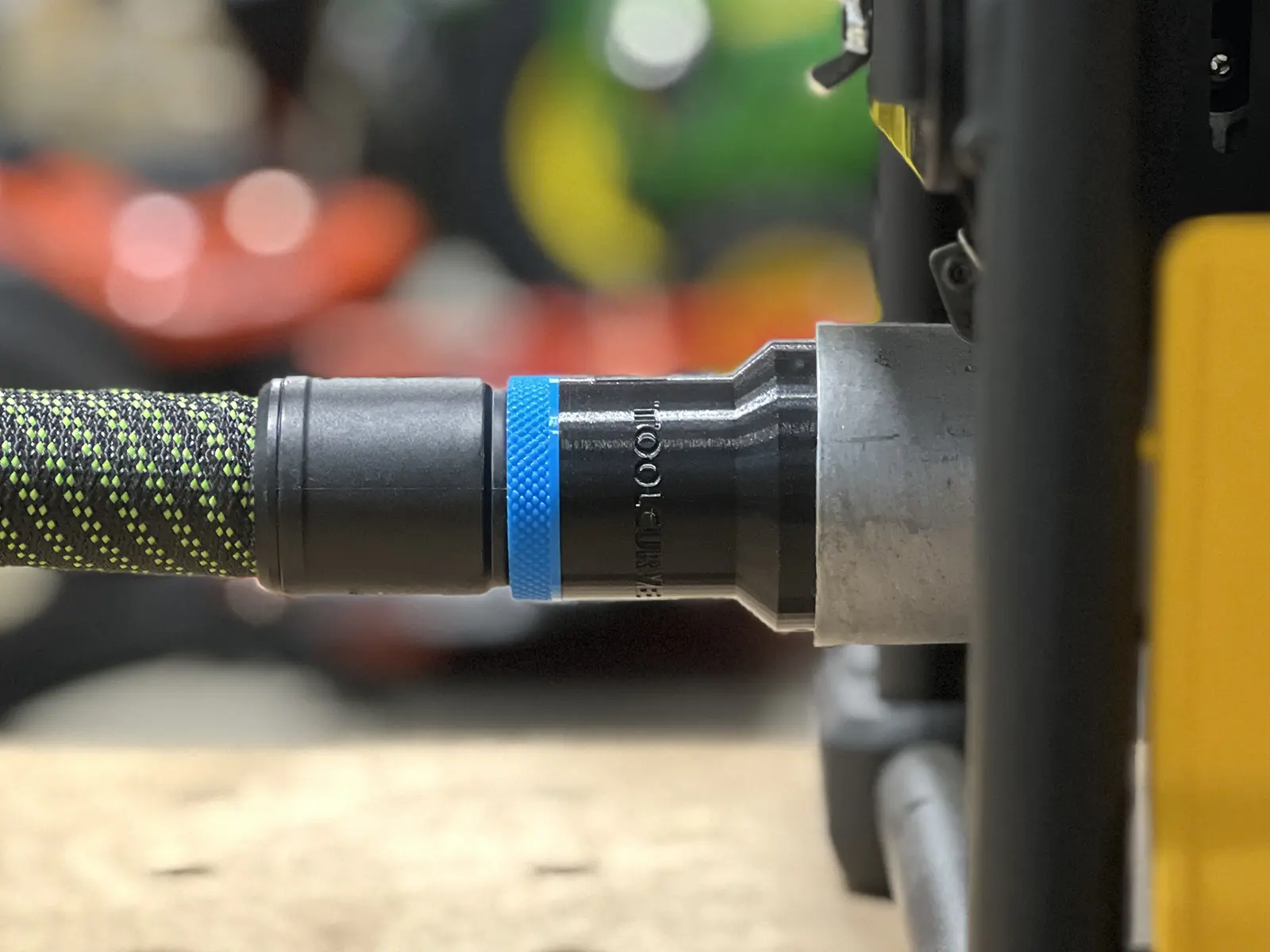
The hose is on the back of your DeWalt DWE7491RS, the vac starts with the saw, and there’s still dust coming off the top of the blade and piling up under the stand. Don’t order another reducer yet. Poor collection after hookup usually comes from one of three problems, and each has a different fix:
Some links in this article go to Amazon. As an Amazon Associate, ToolCurve earns from qualifying purchases.
- A connection problem. The adapter or hose cuff leaks, or it pulls off.
- A blocked dust path. Dust has packed inside the saw, so the vac can’t pull it out.
- An unconnected collection point. The saw has two ports, and you’ve only hooked up one.
Work through them in that order. The first two cost nothing to check.
Our DWE7491RS guide covers the saw’s specs, setup and collection options. This article covers what to do when the hose is connected and collection still disappoints.
First, find your saw’s Type number
DeWalt revises saws over time and marks each revision with a Type number on the saw’s data label. That matters here because the dust access door and the steps for clearing it can change between revisions. The DeWalt DWE7491RS Type 3 manual is the one we’re working from. If your label shows a different Type, get the manual for your Type before you open anything up.
Problem 1: the connection leaks or falls off
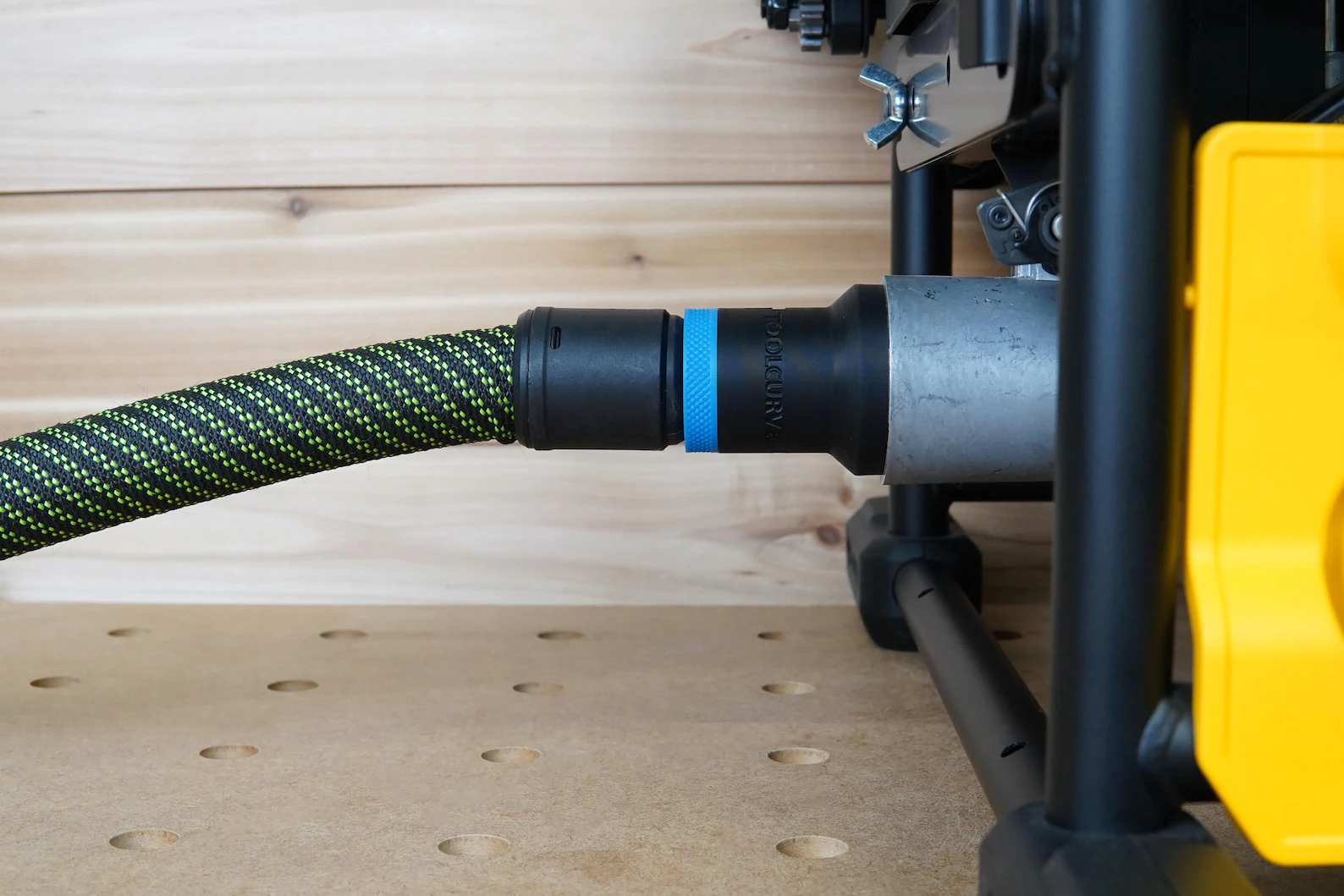
Start at the joints. With the vac running and the saw off, run your hand around each joint. Then do the same at the rear port and at the hose cuff. A loud whistle, a cuff that sits crooked, or a hose that drops off when you move the saw means air is getting in at the joint and not at the blade.
The rear port on this saw measures 2-1/4 inches on the inside. Most vacuum hoses are much smaller, so you need an adapter in between. Our Hose Adapter for Dewalt Table Saw fits that lower rear port and comes in four hose-end options: 27 mm, 36 mm, 1-1/4 inch and 1-7/8 inch.
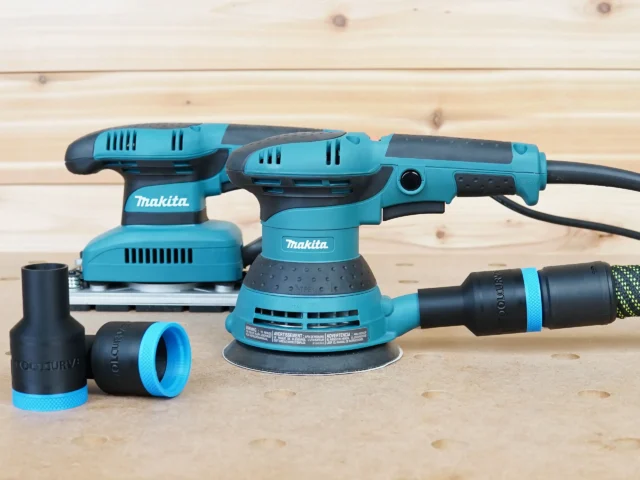
The hose end is where most mismatches happen. Festool, RIDGID and other vac hoses vary by model and by cuff, so measure the end of your hose or check its listing before you pick a size. Don’t guess from the vac’s brand. If you’re still sorting out which size you need, our DeWalt hose adapter guide for Festool and shop vacs walks through it.
If the adapter is seated, the cuff matches and nothing whistles, the connection probably isn’t your problem. Move on.
Problem 2: the dust path is packed
A table saw throws a lot of dust into its lower housing. If that housing packs up, the vac pulls on a clogged passage, and dust ends up back at the blade or on the floor.
Signs to look for:
- The vac sounds strained or changes pitch when it’s connected to the saw. It sounds normal when the hose is pulled off.
- Dust drifts out of openings around the saw body, not just off the top of the blade.
- Collection used to be fine and got worse over time.
Unplug the saw before you reach into the dust path. The DeWalt manual says the same, and it’s the one step not to skip.
The manual describes a dust access door for clearing built-up dust. Where that door is and how it opens depends on your Type, so follow the manual for your revision. Clear out packed dust and any trapped offcuts, close it up, and test again. While you’re back there, also check the rear port itself. A thin strip ripped off a board can wedge in the opening and choke the airflow.
Problem 3: only half the saw is connected
This one catches a lot of people. The DWE7491RS has two collection points:
- The lower rear port collects from the housing under the table.
- The blade guard port collects from above the table, where the blade throws dust toward you.
If only the rear port is connected, the dust that comes off the top of the blade has no place to go. You can have a good seal and a clean housing and still see dust coming off the top. The fix there isn’t a different adapter; it’s a second hose.
DeWalt’s manual recommends connecting the vacuum to both the rear port and the guard port through a Y connector. Our table saw adapter is for the rear port only. The guard port takes its own adapter.
For the guard, we make a separate Hose Adapter for Dewalt Table Saw Dust Blade Guard in 27 mm, 36 mm, 1-1/4, 1-7/8 and 2-1/2 inch. We don’t sell a Y connector, and we haven’t checked a complete two-port setup on one. Before you buy parts, check three things:
- The guard port’s connection size on your saw.
- A Y fitting whose branches match both the rear-port adapter’s hose end and the guard connection.
- The Y’s single end against your vac hose cuff.
We also haven’t measured how much a split setup changes collection. One vacuum pulling through two branches has to share its airflow. So get problems 1 and 2 sorted out before you add the second branch.
Route the hose so it stays out of the way
DeWalt’s manual warns against hose placement that gets in the way of operating the saw. That matters more once you add a hose to the guard. Run the hoses so they don’t snag on the workpiece, the fence or your hands. Keep the rear hose from pulling sideways on the port. A hose that drags or kinks also loses suction. On the rolling stand, check that the hose still reaches when you fold or move the saw. If it doesn’t, it’ll get yanked off the port.
Check the vac end too
Before you blame the saw, pull the hose off the adapter and feel the suction at the open hose end. If it’s weak there, the saw isn’t the problem. Check for a full bag or canister, a clogged filter, or a blockage partway down the hose. A table saw fills a shop vac faster than a sander does, so this check comes up often.
Quick troubleshooting order
| What you see | Likely cause | What to do |
|---|---|---|
| Whistling at the port or cuff, or the hose drops off | Connection mismatch | Reseat the adapter, then confirm the hose-end size against your cuff |
| Weak suction at the open hose end | Vac, filter or hose | Empty the vac, clean the filter, clear the hose |
| Good suction at the hose but poor collection from the saw | Packed lower housing or a blocked port | Unplug the saw, then clear dust using the access-door steps in your Type’s manual |
| Under-table dust is handled, but dust still comes off the top of the blade | Guard port not connected | Plan a Y connection to the guard port and check every fitting size first |
| The hose catches during cuts or when moving the stand | Hose routing | Re-route the hose and add slack where the saw moves |
If you don’t run a vac at all
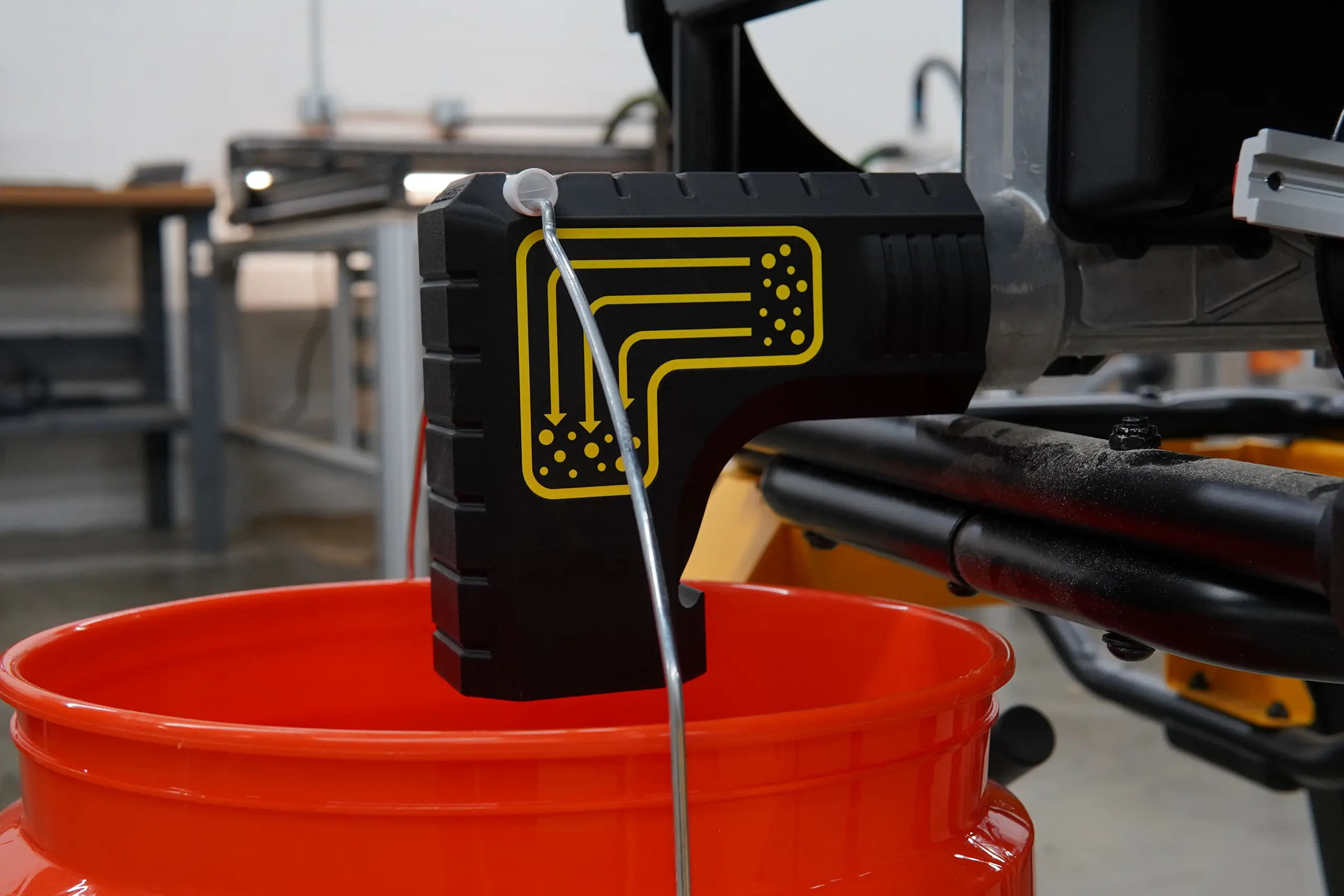
Some people only need to keep the floor under the saw clean, like on a jobsite where a vac isn’t practical. For that, our DeWalt Table Saw Sawdust Bucket Adapter hangs a bucket off the rear dust port to catch what falls out. It’s passive collection, so it won’t do anything for the dust thrown off the top of the blade.
Our take: check the connection, the vac and the dust path before you spend money. Most of these checks are free. If all of that is fine and the dust is coming off the top of the blade, the missing piece is the guard connection, not a new rear adapter.
Comments