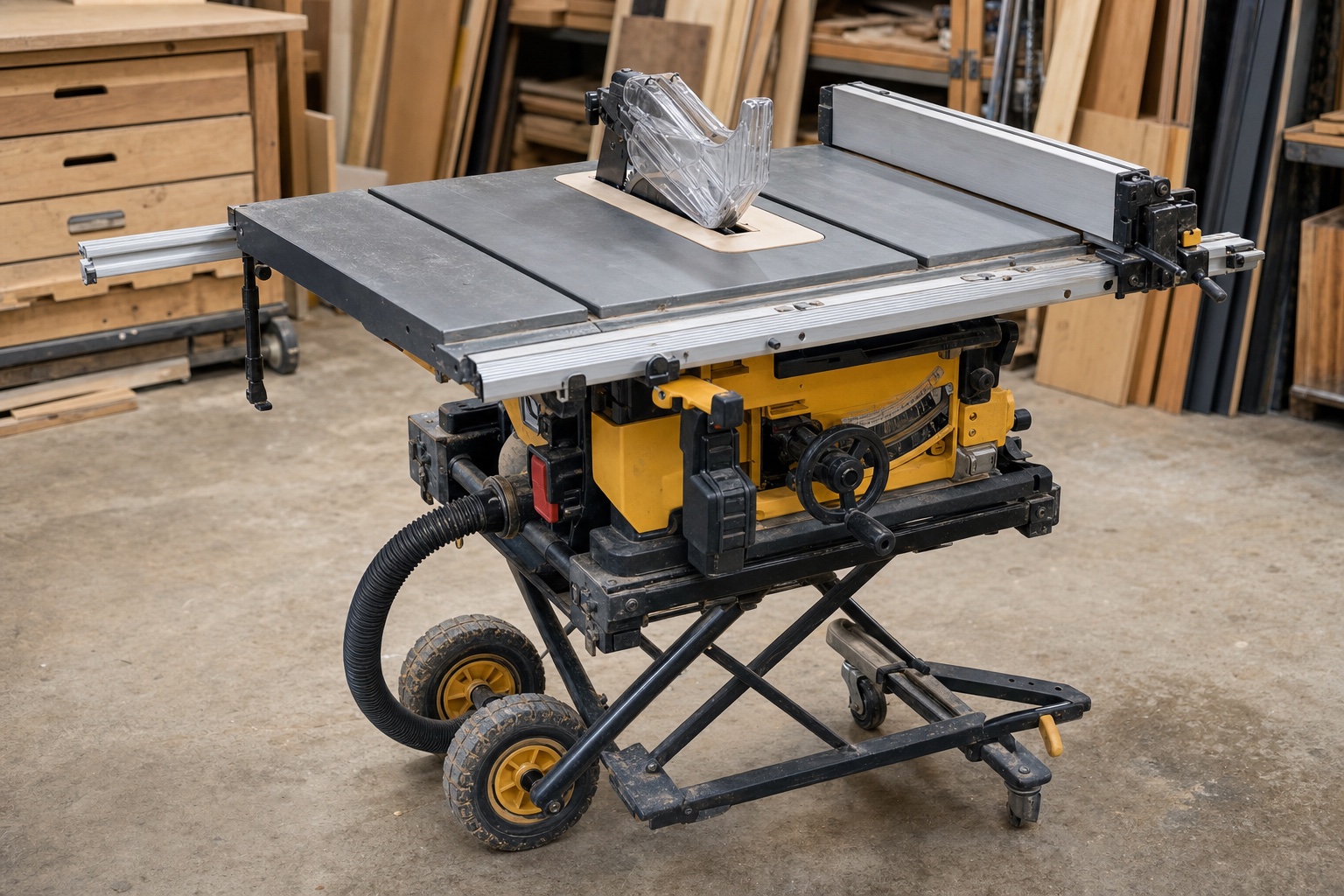
The DeWalt DWE7491RS combines a full-size 10-inch blade and a 32-1/2-inch rip capacity with a rolling stand that can move between a workshop and a jobsite. That capacity is a major part of its appeal, but getting better work from the saw is less about collecting accessories and more about improving three things: setup, workpiece support, and dust control.
This guide explains the saw’s published capabilities, the checks worth making before a cut, and the upgrades that solve specific problems. It is intended as a practical companion—not a replacement for the DeWalt instruction manual.
What the DWE7491RS is designed to do
DeWalt positions the DWE7491RS as a corded jobsite table saw with a rolling stand. Its 15-amp motor drives a 10-inch blade at a published no-load speed of 4,800 rpm. The rack-and-pinion telescoping fence provides up to 32-1/2 inches of rip capacity, enough for many cabinet, shelving, flooring, and trim jobs that would be restrictive on a smaller compact saw.
The saw’s maximum published depth of cut is 3-1/8 inches at 90 degrees and 2-1/4 inches at a 45-degree bevel. Those numbers describe capacity, not the quality of a finished cut. Blade condition, fence alignment, throat-plate support, feed technique, and material stability all influence the result.
Start with alignment before adding accessories
A useful accessory cannot correct a saw that is out of alignment. Before evaluating cut quality, inspect the blade, throat plate, fence, riving knife, guard assembly, and miter gauge according to the manual. Confirm that the fence locks consistently and remains parallel through its travel. Any adjustment or inspection near the blade should be performed with the saw disconnected from power.
Also check the surface supporting the work. The rolling stand is designed for portability and stability, but long or wide stock still needs appropriate infeed, outfeed, and side support. Never rely on the fence or blade to hold an unsupported sheet in position.
When a zero-clearance insert makes sense
The factory throat plate has to accommodate normal blade movement and common saw configurations. That leaves a wider opening around the blade than a dedicated zero-clearance insert. For narrow offcuts and material prone to splintering, a closer-fitting opening can provide more support immediately beside the cut.
The ToolCurve zero-clearance insert for DeWalt 10-inch table saws is listed for the DWE7491RS as well as the DWE7491, DWE7480, DWE7499, DWE745, DWE7490, and DWE7490X. It is CNC-cut from 1/2-inch MDF, supports thin- and full-kerf blades, and includes offset screws for leveling the insert with the saw table.
A zero-clearance insert should be treated as a blade- and setup-specific component. Confirm that the insert is level, stable, and compatible with the blade, kerf, bevel, riving knife, and guarding configuration required for the cut. If the insert contacts the blade or prevents required safety equipment from operating correctly, do not use it for that operation.
Choose dust collection for the way you use the saw
Table-saw dust is difficult because debris moves both below and above the table. The best setup depends on whether the saw stays in a shop, moves between jobs, or is used outside for quick cuts.
Connect the lower port to an extractor or shop vacuum
For active dust collection, ToolCurve’s DeWalt table-saw hose adapter connects to the lower rear dust port. Versions are available for 27 mm and 36 mm European extractor hoses and for 1-1/4-inch and 1-7/8-inch standard hoses. This is especially useful for owners who want to connect a Festool extractor hose to a DeWalt saw without assembling a chain of generic reducers.
Choose the adapter by the hose that will actually be connected—not by the name of the vacuum alone. Festool 27 mm and 36 mm hoses use different connections, and standard shop-vac hoses are commonly sold in more than one nominal size.
Capture dust at the blade guard when the operation allows it
Connecting only below the table cannot capture every particle thrown above the workpiece. The ToolCurve blade-guard dust-port adapter provides options for 27 mm, 36 mm, 1-1/4-inch, 1-7/8-inch, and 2-1/2-inch hoses. Upper collection is most useful when it can be added without compromising the guard’s correct position or interfering with material movement.
Use passive collection when a hose is impractical
An extractor is not always convenient for a few outdoor or jobsite cuts. The DeWalt table-saw sawdust bucket adapter directs chips from the rear port into a small hanging bucket. It will not create suction or match active extraction, but it can keep a substantial portion of coarse debris off the floor when a vacuum hose would be in the way.
Make crosscut fixtures fit the saw
A table-saw sled or purpose-built jig can make repeated crosscuts easier to control, but its runners need to match the saw’s miter slots without binding or excessive side-to-side movement. ToolCurve’s miter bars for DeWalt jobsite table saws are 225 mm long, made from high-density plastic, and supplied as a set of four with countersunk mounting holes.
Before using any shop-built jig, check that it moves freely through the full intended travel and does not interfere with the blade, guard, fence, or controls. A sled design should include appropriate guarding and a positive way to keep hands away from the blade path.
Which upgrade should come first?
The best first upgrade is the one tied to an actual problem:
- For splinter-prone sheet goods or narrow offcuts: consider a properly fitted zero-clearance insert.
- For a stationary shop setup: connect the lower dust port to the correct extractor hose, then consider upper collection when the guard and operation allow it.
- For mobile or outdoor work: passive bucket collection can simplify cleanup without adding another hose.
- For repeatable crosscuts: build a carefully fitted sled or fixture after confirming the saw is aligned.
None of these changes replaces a sharp, suitable blade or correct saw setup. Start with the cut you need to improve, identify what is limiting the result, and change one variable at a time.
DWE7491RS compatibility notes
Model numbers matter. The ToolCurve 10-inch zero-clearance insert explicitly lists the DWE7491RS among its compatible models; the separate 8-1/4-inch insert is intended for models such as the DWE7485 and DCS7485. These inserts are not interchangeable.
Hose fit should also be verified at both ends. The tool-side connection and hose-side connection are different measurements, and nominal hose sizes do not always describe the outside diameter of the cuff. If a saw, hose, or dust port differs from the product description, measure the connection before ordering.
Bottom line
The DWE7491RS already provides the core capacity most users buy it for: a 10-inch blade, a large rip range, a portable stand, and a fence designed for quick adjustment. The most useful upgrades are targeted rather than decorative. Support material close to the blade when the cut calls for it, collect dust in a way that suits the job, and build fixtures only after the saw itself is aligned.
That approach keeps the saw portable while making it more predictable for woodworking, remodeling, and jobsite use.
Comments