The
Some links in this article go to Amazon. As an Amazon Associate, ToolCurve earns from qualifying purchases.
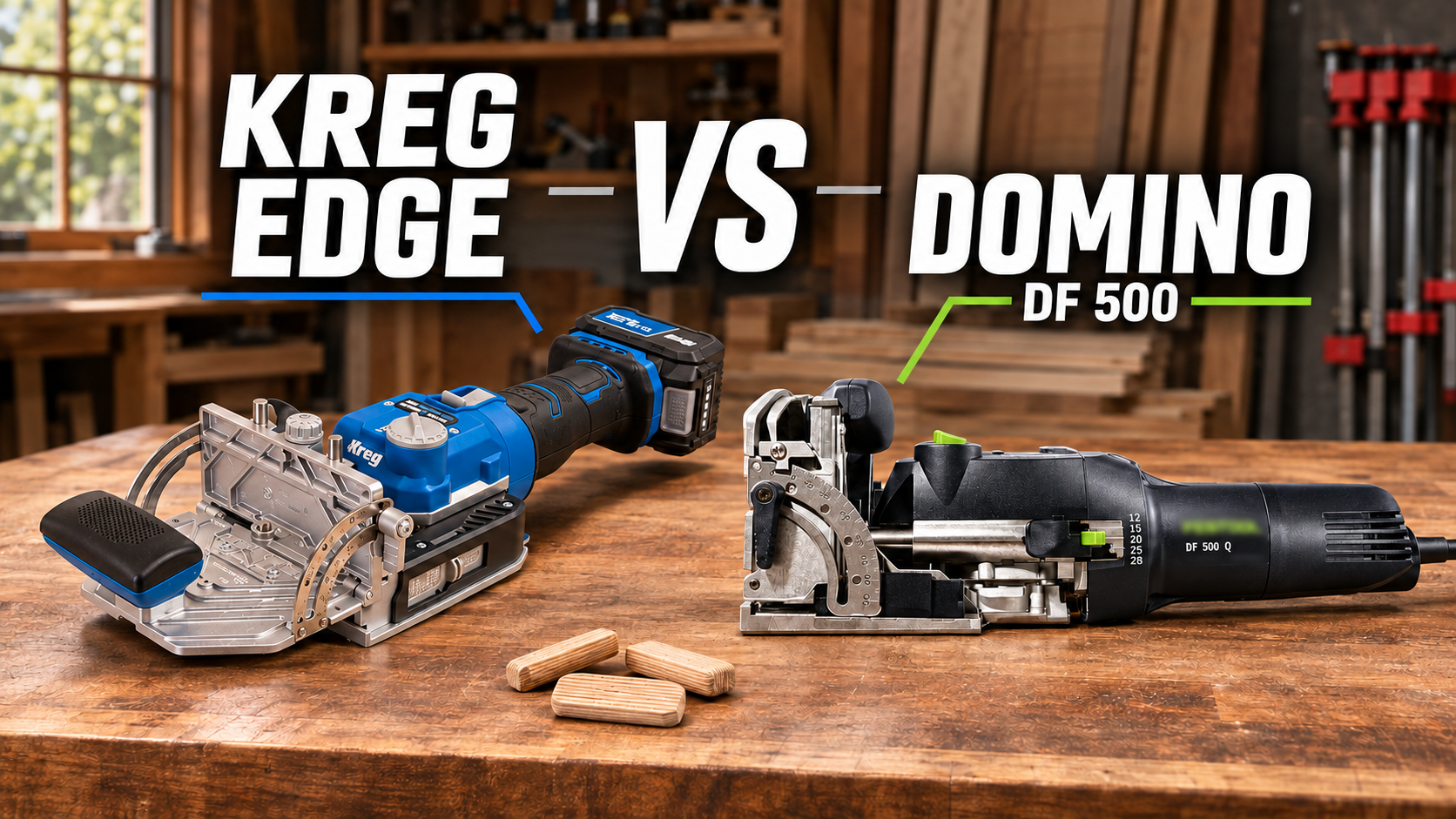
Kreg Edge and Festool DOMINO DF 500 do the same job: they plunge an oval mortise for a loose tenon, quickly and in the same spot every time. That’s about where the similarity ends. The Edge is a 20V cordless tool that uses Kreg’s own 5 to 10 mm cutters and tenons. The DF 500 is a corded 120V machine in Festool’s much older DOMINO system, with cutters from 4 to 10 mm and a long list of accessories.
We make accessories for both of these joiners in our Medina, Ohio shop, so this comparison spends most of its time on the part that trips people up: what actually works with what. The short version is that Kreg says its Edge cutters work in select DOMINO joiners. That’s it. Kreg doesn’t say that about its tenons, batteries, fences, or stops.
Kreg Edge vs. Festool DF 500 specifications
| Specification | Kreg Edge kit | Festool DOMINO DF 500 RQ-Set |
|---|---|---|
| Power | 20V MAX battery; 18V nominal | 120V AC, 420 watts |
| No-load cutter speed | 18,500 RPM | 25,500 RPM |
| Cutter sizes | 5, 6, 8, and 10 mm | 4, 5, 6, 8, and 10 mm |
| Maximum mortise depth | 28 mm | 28 mm |
| Fence angle | 0-90 degrees; positive stops at 0, 22.5, 45, 67.5, and 90 degrees | 0-90 degrees |
| Stated stock range | 7/16 to 2-3/8 inches; manual mode for thicker stock | Routing-height adjustment from 5 to 30 mm; Festool says workpieces can be as thin as 12 mm |
| Dust connection | Built-in chip-relief slots and 1-1/4-inch dust port | 27 mm dust-extraction connection |
| Power-source mobility | Cordless; kit includes 4.0 Ah battery and charger | Corded; 4 m detachable power cord |
Don’t read too much into the RPM line. A higher no-load speed doesn’t tell you which one cuts a cleaner mortise; a sharp cutter and a steady feed matter more. We haven’t timed the two side by side, so we won’t tell you one is faster.
Where the workflows differ
Power and portability
The Edge kit comes with a 4.0 Ah Blue Ion battery and charger, so you can carry it from the bench to an install without hunting for an outlet. That’s the biggest everyday difference between these two. Kreg doesn’t publish how many mortises you get per charge, so if you have a big batch to cut, keep a second battery handy.
The DF 500 runs on a 4 m detachable cord. In a shop that’s barely a drawback, since Festool wants you hooked up to an extractor hose anyway. On a job site the Edge gets rid of the cord, but if you run dust collection you still have a hose to drag around.
Registration, fence setup, and repeat work
Kreg puts a lot of setup help in the box. The fence tilts from 0 to 90 degrees with stops at 0, 22.5, 45, 67.5, and 90. Edge stops line up matching mortises, the Narrow Stock Guide centers the cut on skinny parts, and the Stability Base gives you a bigger surface when you’re mortising into a face. There’s also a micro-adjust fence and a one-touch width setting for when you want a little play in the joint.
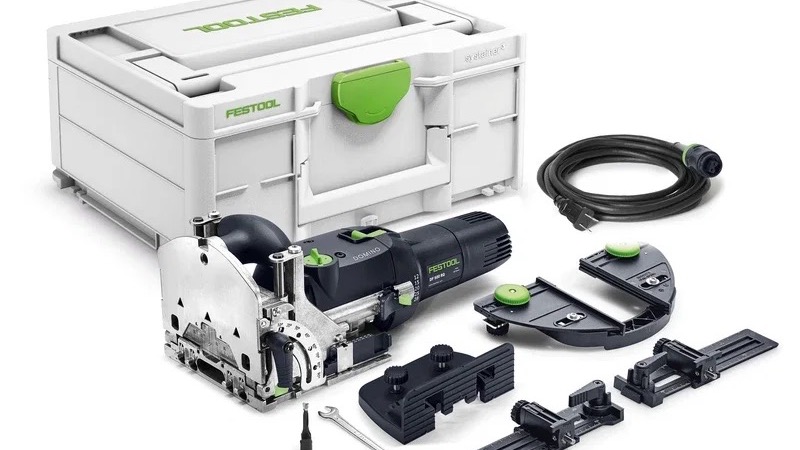
The DF 500 handles repeat work its own way. It has built-in indexing pins and depth presets at 12, 15, 20, 25, and 28 mm, and the RQ-Set adds a support bracket, trim stop, and cross stop so you can space mortises without marking out every one. Neither approach wins on paper. Pick the one that suits the parts you cut most often.
Thin stock and cutter range
The DF 500’s 4 mm cutter is a real advantage on small parts. Festool says it can join stock as thin as 12 mm, and DOMINO tenons run from 4 x 20 mm up to 10 x 50 mm. The Edge starts at 5 mm and is rated for 7/16″ to 2-3/8″ stock, with a manual mode for anything thicker. For cabinets, face frames, and tables, either one is fine. For thin drawer parts and small frames, or if you already have a box of 4 mm DOMINO tenons, the Festool goes one size smaller.
Chip collection and dust extraction
Kreg built chip-relief slots into the Edge so you can do short runs without a vacuum, and it has a 1-1/4″ dust port for longer sessions. If your shop vac or extractor hose doesn’t match that port, our Kreg Edge hose adapter connects the two. We make it here in Ohio and label each one by hose size.
Festool wants a dust extractor on the 27 mm port every time. Deep mortises pack with chips quickly, and a packed mortise gives you a sloppy joint. On either tool, if the cut starts to bog down, back out and clear the chips instead of pushing harder. Wear a dust mask either way.
What actually works with what?
Kreg cutters in a DOMINO: sometimes
Kreg sells 5, 6, 8, and 10 mm carbide-tipped Edge cutters and says they work in select Festool DOMINO joiners. That’s the only crossover either company stands behind. The DF 500 takes those four sizes plus its own 4 mm.
The word “select” matters. Kreg doesn’t say every DOMINO, and the DF 700 is a bigger machine with a different cutter range. Check Kreg’s list against the model number on your joiner before you install one. It doesn’t work the other way around either: neither company says Festool cutters belong in the Edge.
Tenons: don’t mix brands
Kreg’s 5, 6, 8, and 10 mm hardwood tenons are made for mortises cut by the Edge and the MortiseMate. Festool’s DOMINO tenons have their own lengths, flutes, and glue pockets. Even when the thickness matches, the width, length, corner shape, and glue room can be off.
So even if a Kreg cutter works in your DOMINO, that doesn’t mean Kreg tenons belong in a DOMINO mortise, or DOMINO tenons in an Edge mortise. Our advice is to use one brand of tenon per machine. If you do try a mixed setup, test the fit in scrap before you glue up project parts.
Batteries and accessories stay with their own tool
Kreg’s Blue Ion batteries are for Kreg’s 20V tools. The corded DF 500 doesn’t use one, and the cordless DFC 500 runs on Festool’s 18V batteries. The Edge’s guide, base, stops, and fence are shaped for the Edge, and the DOMINO’s bracket, stops, and fences are shaped for the DOMINO. Neither company says they swap between brands, and we wouldn’t count on it.
Festool also makes a cordless DOMINO
If you’re thinking of this as “cordless Kreg vs. corded Festool,” you’re missing one. Festool’s DFC 500 is an 18V cordless DOMINO with the same 4 to 10 mm cutters, the same 28 mm maximum depth, a 27 mm dust port, and 18,500 RPM, the same no-load speed as the Edge. The DFC 500 E-Basic comes without a battery or charger, so what it really costs you depends on whether you already own Festool 18V batteries.
That doesn’t make the Edge a bad buy. But if you want cordless and you’d rather stay with DOMINO tenons and accessories, put the DFC 500 on your list before you decide.
Which joiner fits your shop?
Choose the Kreg Edge if…
- You want a cordless kit with the battery and charger in the box.
- Your work fits 5, 6, 8, and 10 mm tenons.
- You’ll actually use the Narrow Stock Guide and Stability Base.
- You’d rather set up in inches.
- You want the lower starting price and don’t mind building up a new supply of cutters and tenons.
Choose the Festool DF 500 R if…
- You already own DOMINO cutters, tenons, stops, or an extractor.
- You need the 4 mm size for thin or small parts.
- You’ll use the RQ-Set’s cross stop, trim stop, and support bracket.
- You want the bigger selection of DOMINO tenons and accessories.
- You mostly work at the bench and plug into an extractor anyway.
Already own a DF 500?
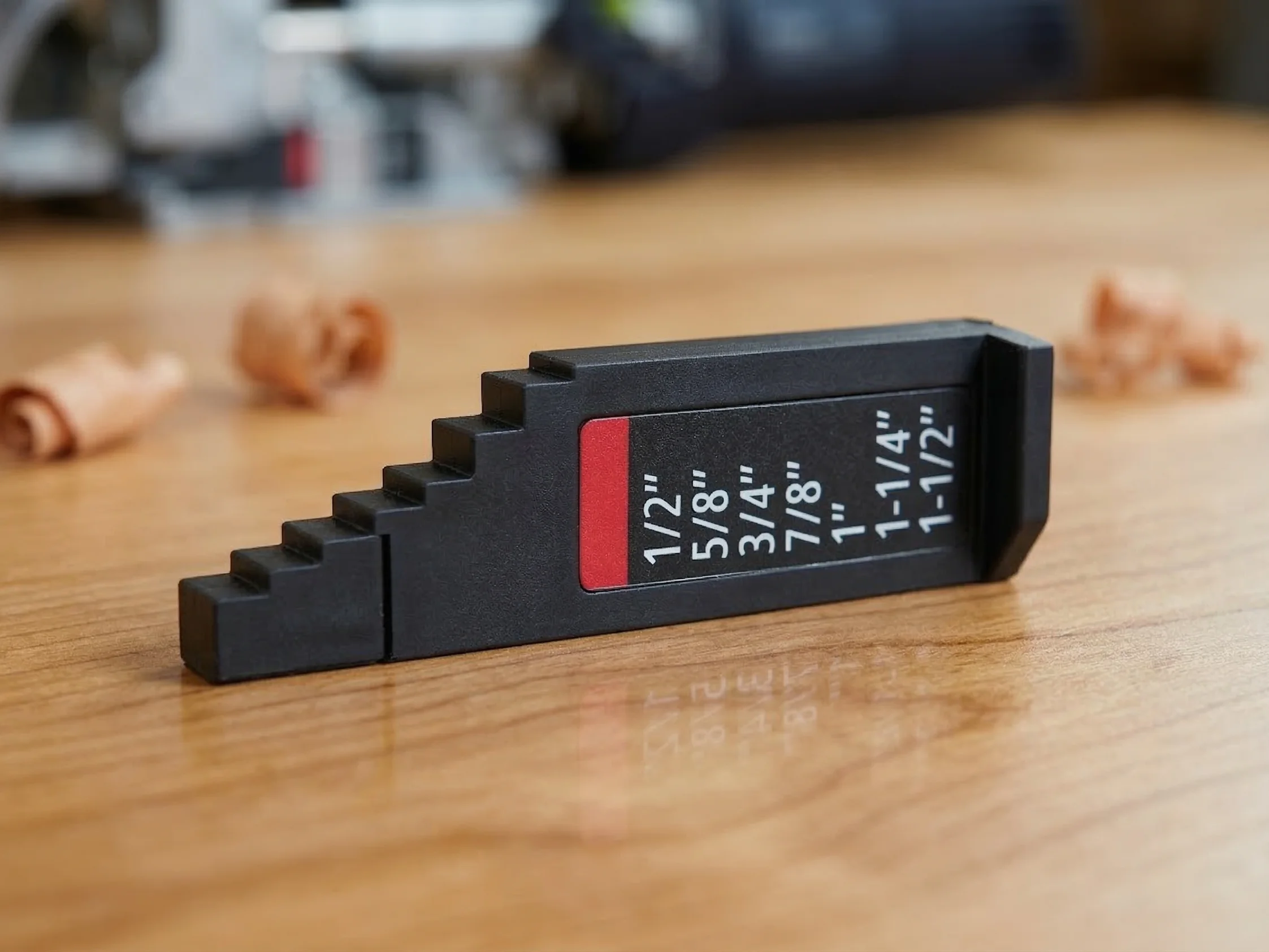
You don’t need a new machine to make it easier to use in an inch-based shop. Our DF 500 Imperial Thickness Gauge puts common fractional thicknesses right on the fence, so you’re not converting millimeters every time you set the height. It’s only a setup aid and doesn’t change which cutters or tenons work. Our installation guide shows how it goes on.
Before your first project
- Pick a system before you buy tenons in bulk. A cutter that crosses over doesn’t mean the tenons do.
- Read the manual for your exact model. Kits change, so go by the model number on the machine, not the name on a store listing.
- Pull the battery or unplug it before you change a cutter, attach a stop, or adjust anything near the cutter.
- Cut a test joint in scrap. Check fence height, depth, mortise width, and tenon fit before you touch project parts.
- Clamp your work. Use the base, bracket, or narrow-stock guide when the fence can’t sit flat on its own.
- Keep the mortise clear. Hook up extraction for long sessions and don’t force the plunge.
These are two different systems that cut the same kind of joint. Buy the one that matches the work you do and the tools already on your shelf.
Comments