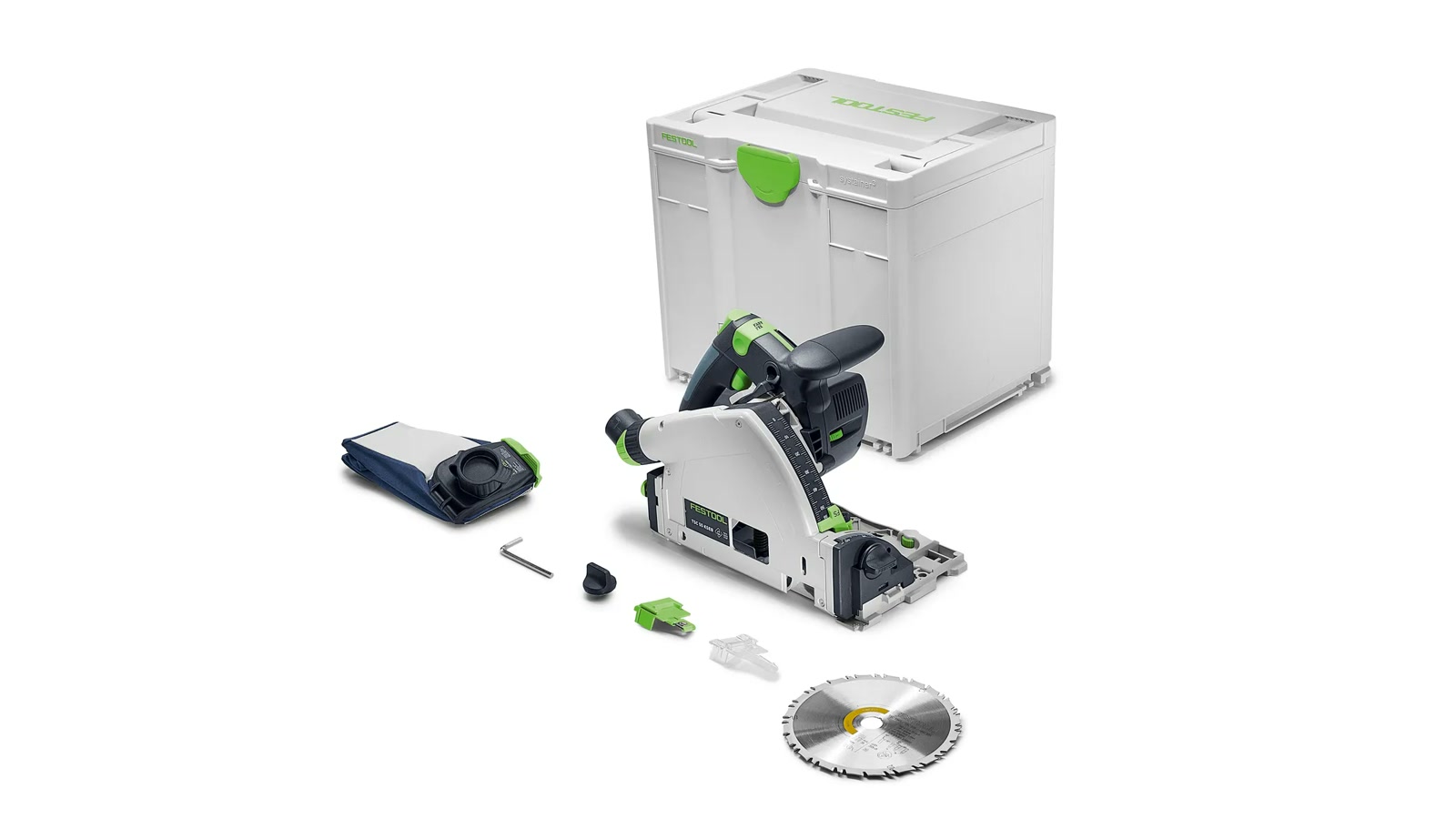
Festool’s 2026 TSC 55 KS and HKC 55 K may share a blade diameter, battery platform, and 55 mm maximum cutting class, but they remain tools for different jobs. The TSC 55 KS is the plunge-cut track saw for breaking down sheet goods, trimming doors, and making controlled plunge cuts. The HKC 55 K is the carpentry saw: it combines the freehand behavior of a guarded circular saw with Festool’s FSK cross-cutting rails and FS guide rails.
The update is more than a model-name change. The TSC moves from the previous generation’s two-battery arrangement to a single 18V pack, while the HKC gains sensor-based KickbackStop and a higher no-load speed. Both are designed around Festool’s new thin-kerf blades and TBX 8 Tabless Battery. Festool USA now lists the TSC 55 KSEB-Basic as article 577991 and the HKC 55 KEB-F-Basic as article 578303.
The short version
- Choose the TSC 55 KS when the rail-guided plunge cut is the main requirement: cabinet panels, doors, countertops, flooring, and other finish work where a controlled start and a splinter-conscious cut matter.
- Choose the HKC 55 K when jobsite crosscuts, framing, decking, and repeated angled cuts matter most. It works with FSK cross-cutting rails and also runs on Festool FS guide rails for straight cuts.
- The 2026 TSC headline is one-battery operation. The outgoing TSC 55 K page specifies 2 x 18V, while the TSC 55 KS page specifies 18V and describes a single-battery design.
- The 2026 HKC headline is speed plus active kickback response. Its listed no-load speed is 5,200 RPM versus 4,500 RPM for the previous HKC 55, and Festool adds sensor-based KickbackStop.
- Both favor the TBX 8 for demanding work but remain compatible with Festool’s 5.0 Ah pack, according to the current product pages.
TSC 55 KS: the major change is the power layout
The previous TSC 55 K was a dual-battery saw. Festool’s archived current-generation page specifies 2 x 18V and a 2,650–3,800/5,200 RPM speed range. The new TSC 55 KS uses one 18V battery and is rated at 3,500–5,200 RPM. That does not change the upper speed figure, but it materially changes how the tool is carried and managed: one battery can be on the saw while another charges, instead of two packs being installed for operation.
Festool lists the new saw at 7.80 lb and the previous model at 7.94 lb. Those page figures are close, so the more useful takeaway is not a dramatic catalog-weight reduction; it is the slimmer, single-pack layout. Festool also says the motor housing stays within the guide-rail width, which is intended to reduce snagging against clamps or workpiece edges.
The cutting envelope stays familiar. The TSC 55 KS uses a 6-1/4-inch (160 mm) blade, cuts from 0 to 2-1/8 inches (55 mm) at 90 degrees, reaches 1-11/16 inches (43 mm) at 45 degrees, and offers a -1 to 47 degree bevel range. Its dust connection accepts 27 mm and 36 mm hoses. For help choosing between those hose sizes, see ToolCurve’s Festool hose-size guide.
The saw retains sensor-based KickbackStop. Festool says the system detects a kickback event, stops the blade quickly, and can be reset so work can continue. That is a risk-reduction feature, not a substitute for secure work support, a sound blade, correct rail setup, or the operating instructions.
Dust collection and the new TSC details
Festool revised the TSC’s included dust bag and gave the dust port a lockable, 360-degree articulating design. The bag is useful where a hose would restrict movement; a connected extractor is the better fit when continuous collection matters. The slimmer housing, a clearer sight window, dual depth pointers, and an optional work light round out the practical refinements described on the product page.
Festool attributes up to 31% longer runtime to the TSC 55 KS when it is paired with the TBX 8. Treat that as a manufacturer performance claim: Festool’s public release does not provide enough test-condition detail to turn it into a universal number for every material, blade, depth, or feed rate. Blade sharpness and kerf, battery temperature, cutting depth, and material density will all affect real runtime.
HKC 55 K: faster cutting and KickbackStop
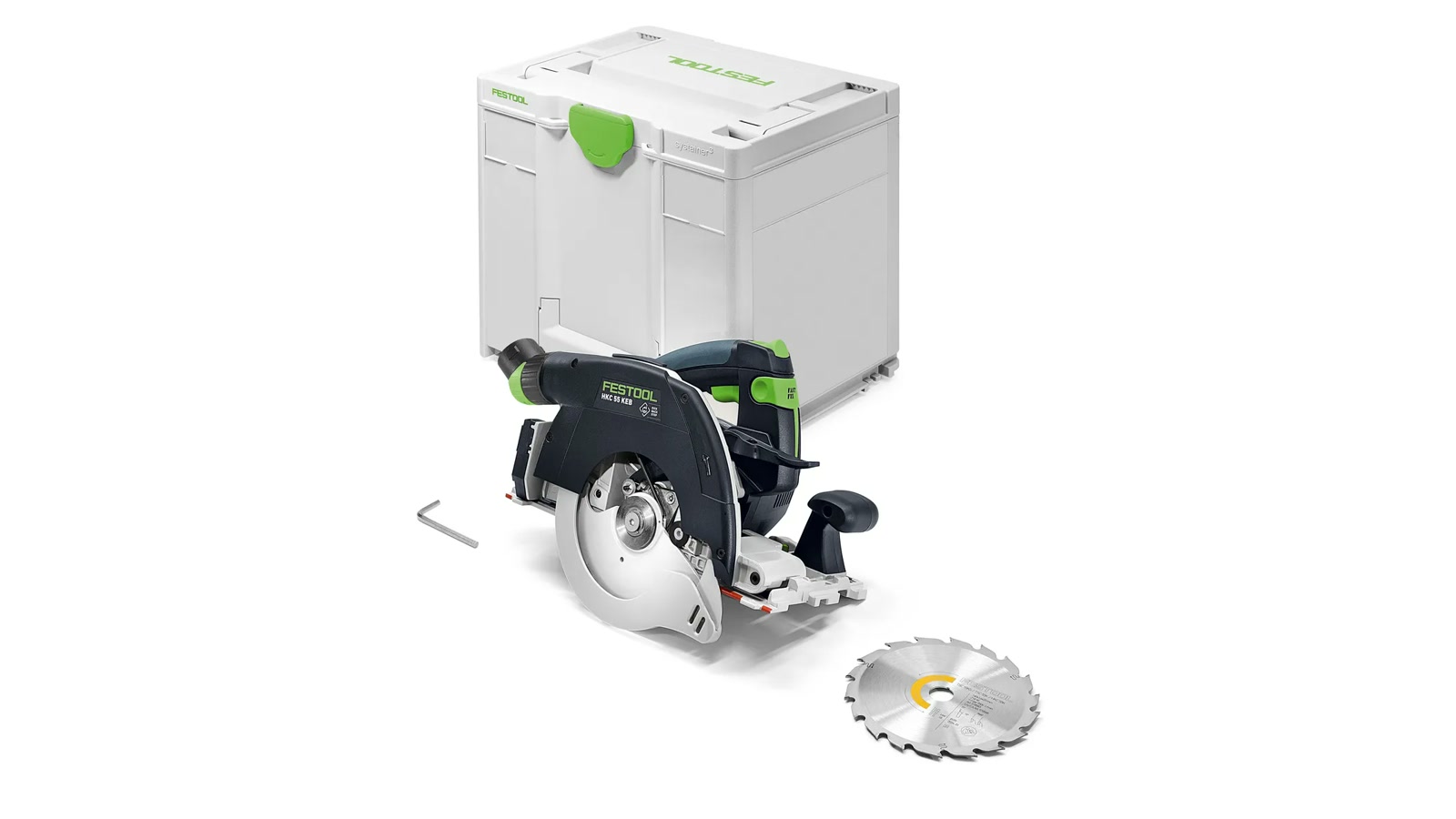
The HKC remains the saw for carpentry-style cutting rather than a TSC replacement. It has a conventional spring-loaded guard, a built-in riving knife, and a plunge setting. With an FSK 250, 420, or 670 cross-cutting rail, it becomes a portable system for repeatable crosscuts and angles; with an FS rail, it can make guided rip and straight cuts. That flexibility is the reason to choose it over a track saw when a job mixes freehand cuts, framing cuts, and rail-guided work.
The previous HKC 55 page lists 4,500 RPM. The HKC 55 K is rated at 5,200 RPM and uses a 1.6 mm thin-kerf blade instead of the older page’s 1.8 mm blade. Festool says the combination can cut up to three times faster. As with the runtime figure, that is an attributed manufacturer claim rather than an independent ToolCurve test, and actual improvement will depend on material and blade choice.
The more important safety-system change is KickbackStop. Festool says a sensor reacts to kickback by stopping the motor and blade, while the riving knife helps prevent the kerf from closing on the blade. The HKC 55 K also adds app connectivity for battery state, motor temperature, KickbackStop status, and software updates.
Core capacities are largely unchanged: 18V, a 6-1/4-inch (160 mm) blade, a 0 to 50 degree bevel range, 7.94 lb listed weight, and 27/36 mm dust extraction. Festool lists 42 mm and 38 mm cutting-depth figures at 45 degrees, reflecting use without and with a rail. Its current page describes cuts in material up to 2-1/8 inches (55 mm) thick at 90 degrees.
What the TBX 8 contributes
The BP 18 TBX 8 ASI is an 18V, 8.0 Ah Bluetooth battery weighing 2.2 lb. Its tabless cell construction reduces internal resistance and heat compared with a conventional tabbed connection design. Festool pairs it with AIRSTREAM cooling and says an SCA 16 rapid charger can return it to ready status in as little as 25 minutes. The battery can also trigger a paired Bluetooth CLEANTEC extractor and report charge level, temperature, and usage data through the Festool app.
Capacity has a handling tradeoff. The TBX 8 is the performance-oriented choice for the two saws, but it is heavier than a compact pack. Both saw pages also list compatibility with the 5.0 Ah Li-HighPower battery. Users who value lower carried weight for intermittent cuts may prefer the smaller pack; users making long, high-load cuts are the clearer TBX 8 audience.
Guide rails and repeatable stops
The guide-rail distinction is easy to miss. The TSC is designed around an FS guide rail for plunge and straight cuts. The HKC can use that same FS rail, but its distinctive feature is compatibility with self-returning FSK cross-cutting rails. An FSK rail travels with the HKC and provides indexed angles for repeatable crosscuts; it is not simply a shorter FS rail.
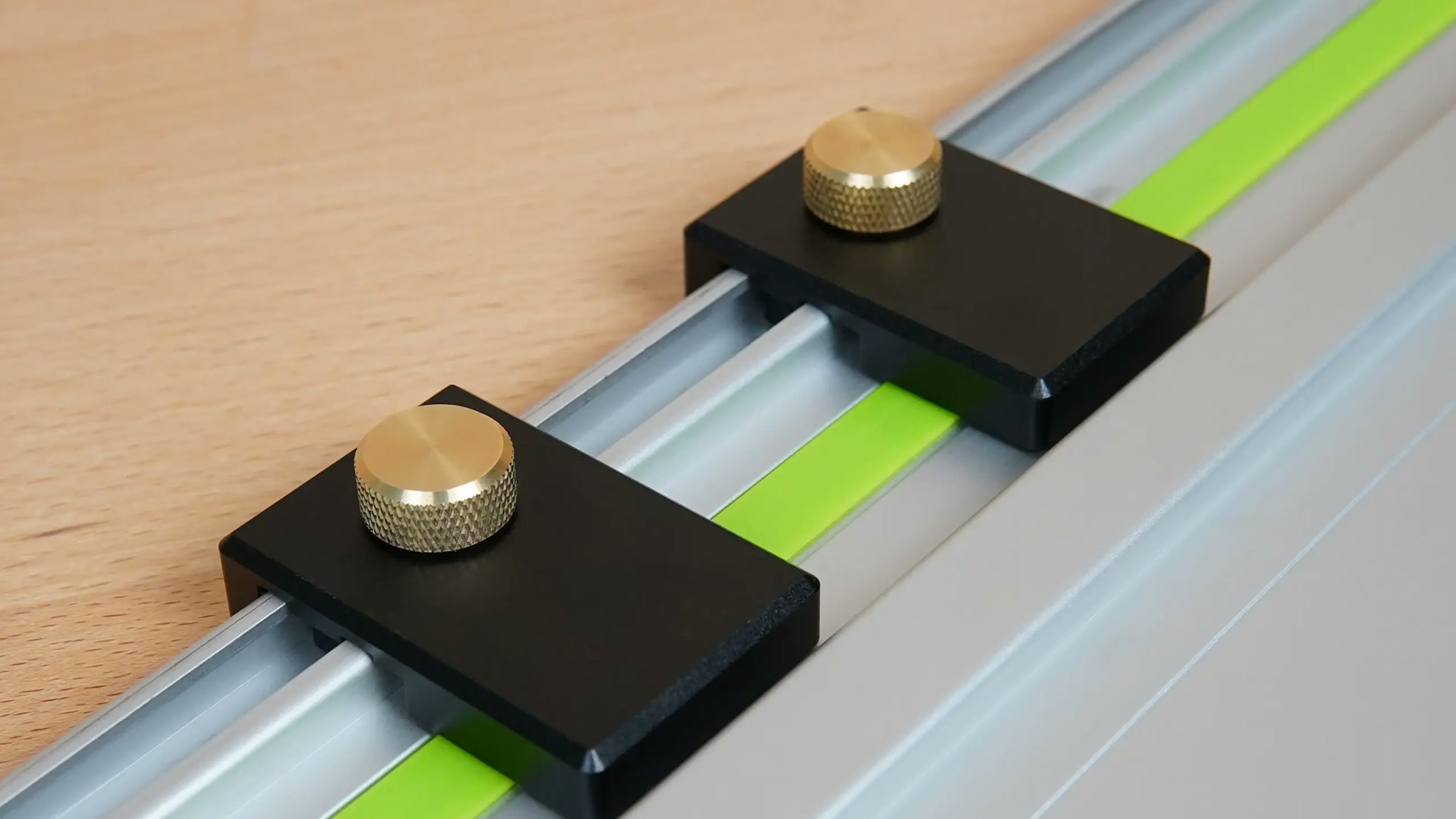
For an FS-style setup, ToolCurve Guide Rail Limit Stops can provide physical start and end references for repeat cuts on a compatible rail. The product is currently in stock in ToolCurve’s refreshed catalog. Because the stop fits the rail rather than the saw, check the product page’s current rail compatibility before choosing a variation. Do not assume that an accessory labeled for an older TSC or HKC automatically fits a 2026 saw unless its maker explicitly adds the new model.
Which 2026 Festool saw should you buy?
Buy the TSC 55 KS if you primarily cut sheet goods, doors, countertops, flooring, or finish panels on a guide rail and need true plunge capability. The single-battery design is the clearest reason for an existing cordless Festool user to look at the update, while the revised dust hardware and slimmer housing make everyday rail work more convenient.
Buy the HKC 55 K if the work happens around framing lumber, roof battens, decking, cladding, or repeated crosscuts. It is the more flexible jobsite circular saw, especially with an FSK rail. The higher listed speed and addition of KickbackStop are meaningful updates, but its cutting role remains different from the TSC.
If you already own the prior versions, capacity alone is not a reason to switch: blade diameter, maximum depth class, and bevel ranges are broadly familiar. The upgrade case is strongest when the new operating behavior solves a real problem—one-battery handling and revised dust management on the TSC, or KickbackStop and higher cutting speed on the HKC. ToolCurve has not independently tested either 2026 saw, so final buying decisions should also account for hands-on ergonomics, the exact set contents, and Festool’s latest dealer availability.
Comments