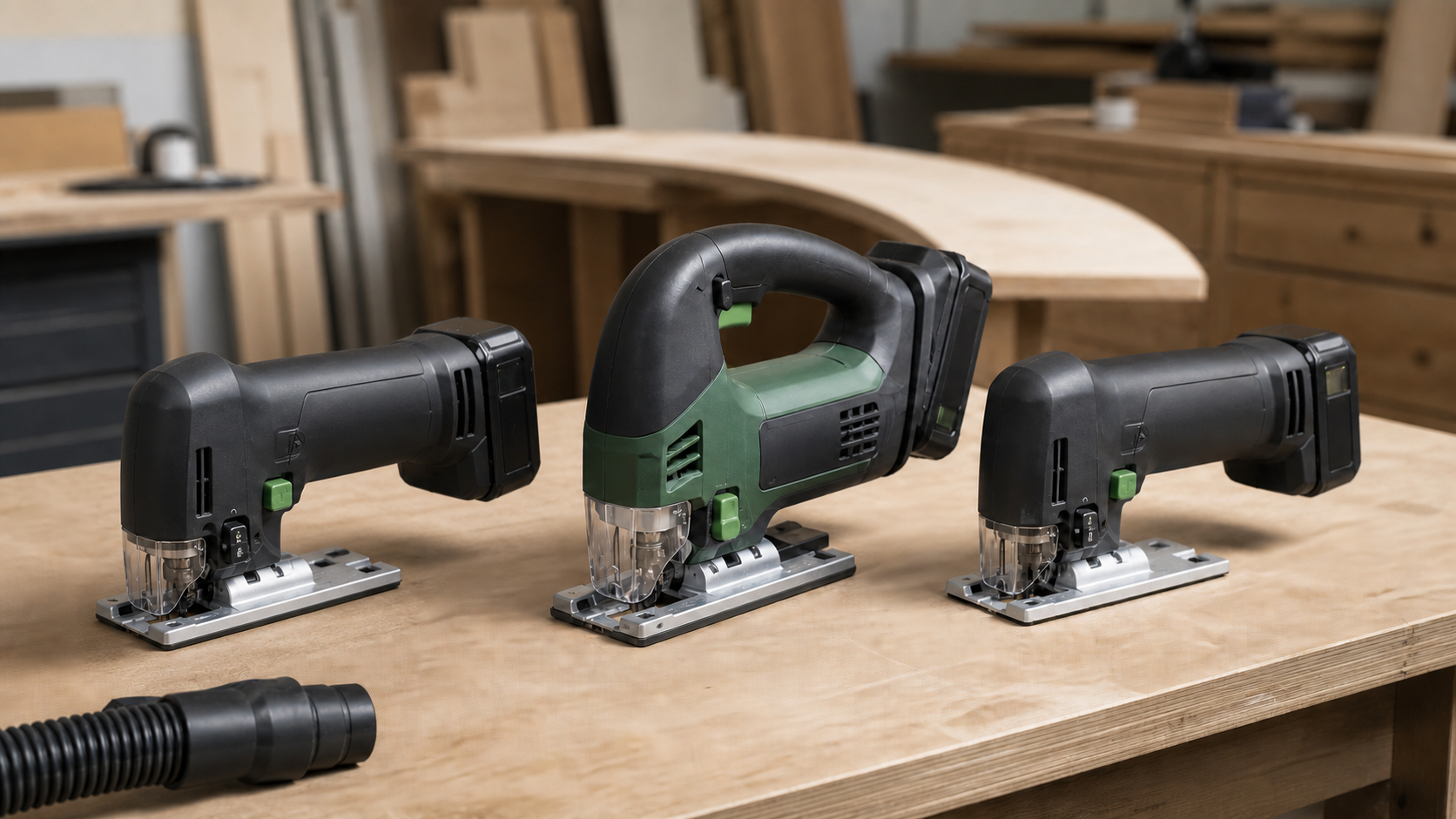
The short answer: choose the Festool PSC 500 if you want the new 120 mm-capacity platform with a barrel-style grip, or the PSBC 500 if you prefer a bow handle. Festool describes those two models as sharing the same performance platform, so the handle is the central difference. The PSC-E 18 is a different proposition: it is lighter, has a fixed 90-degree base, and is rated for wood up to 40 mm. It makes more sense for controlled assembly and interior work than for shoppers seeking the full capacity of the PSC 500 or PSBC 500.
This guide is based on Festool’s international announcement and current UK product information. It is not a hands-on review, and U.S. pricing and availability had not been confirmed when the sources were checked. Model names, packages, and release timing can differ by market, so U.S. buyers should verify the final local configuration before ordering.
PSC 500, PSBC 500 and PSC-E 18 at a glance
| Model | Grip and role | Maximum wood capacity | Base | Published bare-tool weight |
|---|---|---|---|---|
| PSC 500 | Barrel/knob grip; full-capacity cutting | 120 mm | Tilts to ±45 degrees with a 0-degree detent | 2.20 kg on the cited UK configuration |
| PSBC 500 | Bow handle; full-capacity cutting | 120 mm | Tilts to ±45 degrees with a 0-degree detent | Verify by local configuration |
| PSC-E 18 | Compact barrel-style body; assembly and interior work | 40 mm | Fixed at 90 degrees | 1.70 kg without battery |
The table highlights why the PSC-E 18 should not be treated as merely a smaller-package version of the other two. Its lower capacity and fixed base narrow its intended job range, while its lower weight can be valuable when making repeated, controlled cuts during fitting work.
PSC 500 vs. PSBC 500: the grip is the main choice
Festool’s announcement places the PSC 500 and PSBC 500 on the same technical platform. Both are 18-volt cordless pendulum jigsaws with a published maximum cutting depth of 120 mm in wood, an adjustable pendulum action, variable speed, a tilting table, and an enhanced three-part blade guidance system. Both also include features intended to keep the cut line visible, including a blower and an LED light that can be adjusted through the Festool Work app.
The PSC 500 uses a low barrel or knob grip. Many woodworkers like this format because the hand stays close to the workpiece and the tool can feel direct when following curves or a marked line. The PSBC 500 adds a bow-style top handle. That arrangement can be more familiar if you learned on a traditional D-handle jigsaw or regularly reposition the tool between cuts.
Grip preference is personal, and specifications alone cannot decide which feels better in your hand. If possible, handle both versions with the battery you expect to use. Check trigger reach, wrist angle, line-of-sight, and how easily you can guide the saw without squeezing harder than necessary. Those details matter more over a long work session than a minor difference on a feature list.
Where the PSC-E 18 fits
The PSC-E 18 is the focused option in the group. Festool lists a 40 mm maximum cutting depth in wood, a 23 mm stroke, 800 to 3,500 strokes per minute, and four pendulum settings. Its table remains fixed at 90 degrees. The cited bare-tool weight is 1.70 kg, compared with 2.20 kg for the cited PSC 500 configuration.
That combination favors tasks such as fitting cabinets, trimming interior components, making cutouts, and handling thinner stock where a beveling base and 120 mm capacity are unnecessary. A fixed table also removes a setup variable when the goal is a straightforward square cut. On the other hand, the PSC-E 18 is not the right substitute when you need the deeper capacity or angled-base flexibility of the PSC 500 and PSBC 500.
Blade control, splinter protection and blade selection
All three models use Festool’s three-part blade guidance concept, and Festool lists the same SP-PSC 500/5 splinterguard as compatible with the PSC-E 18, PSC 500 and PSBC 500. Festool’s STS-SORT/21 WMP blade assortment is also listed for all three models as well as several earlier Festool jigsaws. That shared accessory support should make it easier for an existing Festool user to organize blades and consumables, but the blade still has to match the material and cut.
For clean plywood or laminate work, use a blade geometry intended for clean faces and install a fresh splinterguard where appropriate. For tight curves, choose a narrower blade that can turn without being forced. For thicker stock, use a blade with sufficient length and stiffness, then slow down and let the teeth clear the kerf. A 120 mm capacity rating does not mean every blade or material will cut equally well at that depth.
Dust extraction and a clearer cut line
Festool lists extraction connections for the new jigsaws, and the PSC 500 information also describes Bluetooth-based extractor control. Extraction can help keep chips away from the cut line and reduce cleanup, especially during indoor fitting or repeated sheet-good cuts. It does not make jigsaw work dust-free: the blade moves through an open kerf, and some debris will escape around the base.
The practical setup is a hose that moves freely without pulling the back of the saw off line. Support the hose behind the work, leave enough slack for the entire cut, and test the path before starting. ToolCurve specializes in adapting dust hoses across mixed-brand shops; however, we have not attached a model-specific adapter to this article because the current catalog data did not establish a verified fit for these new jigsaws. Measure the final port and confirm the exact regional tool configuration before selecting an adapter.
Availability and regional details
Festool’s international announcement states that the PSC 500 and PSBC 500 are scheduled to reach specialist retailers on September 7, 2026, while the PSC-E 18 has been available in the referenced market since April 2026. The same announcement directs readers to a UK site and notes that product versions can vary by country.
That makes the date useful for tracking the platform, but it should not be read as a confirmed U.S. launch date. Before planning a purchase, check Festool USA or an authorized U.S. dealer for the local model number, included accessories, battery and charger package, warranty terms, price, and actual delivery date.
Which Festool cordless jigsaw should you choose?
- Choose the PSC 500 if you want the full 120 mm platform, prefer a low barrel-style grip, and may use angled base settings.
- Choose the PSBC 500 if you want the same stated cutting platform but prefer a conventional bow handle.
- Choose the PSC-E 18 if low weight, a fixed square base, and controlled cutting in material up to 40 mm fit your assembly and interior workflow.
- Wait for U.S. details if local availability, exact packages, or existing battery compatibility will determine the purchase.
Setup and safety reminders
Remove the battery before installing a blade, adjusting the base, clearing a jam, or working around the blade guide. Confirm that the blade locks fully into the tool and extends through the material throughout the stroke. Clamp or support the work so the offcut cannot pinch the blade, and inspect the underside for fasteners, wiring, or unsupported material before cutting.
Wear appropriate eye and hearing protection and follow the tool manual for the material being cut. Use suitable respiratory protection where required. Dust extraction is a useful control and housekeeping aid, but it does not replace safe work practices or material-specific dust precautions.
Bottom line
The PSC 500 and PSBC 500 are the closest comparison: they share Festool’s new high-capacity jigsaw platform and separate mainly on grip style. The PSC-E 18 prioritizes lower weight and a fixed 90-degree setup for lighter assembly work. The best choice therefore starts with the cuts you actually make, then narrows by capacity, base adjustment, preferred hand position, and local availability—not by assuming that the newest or largest model is automatically the best fit.
Comments