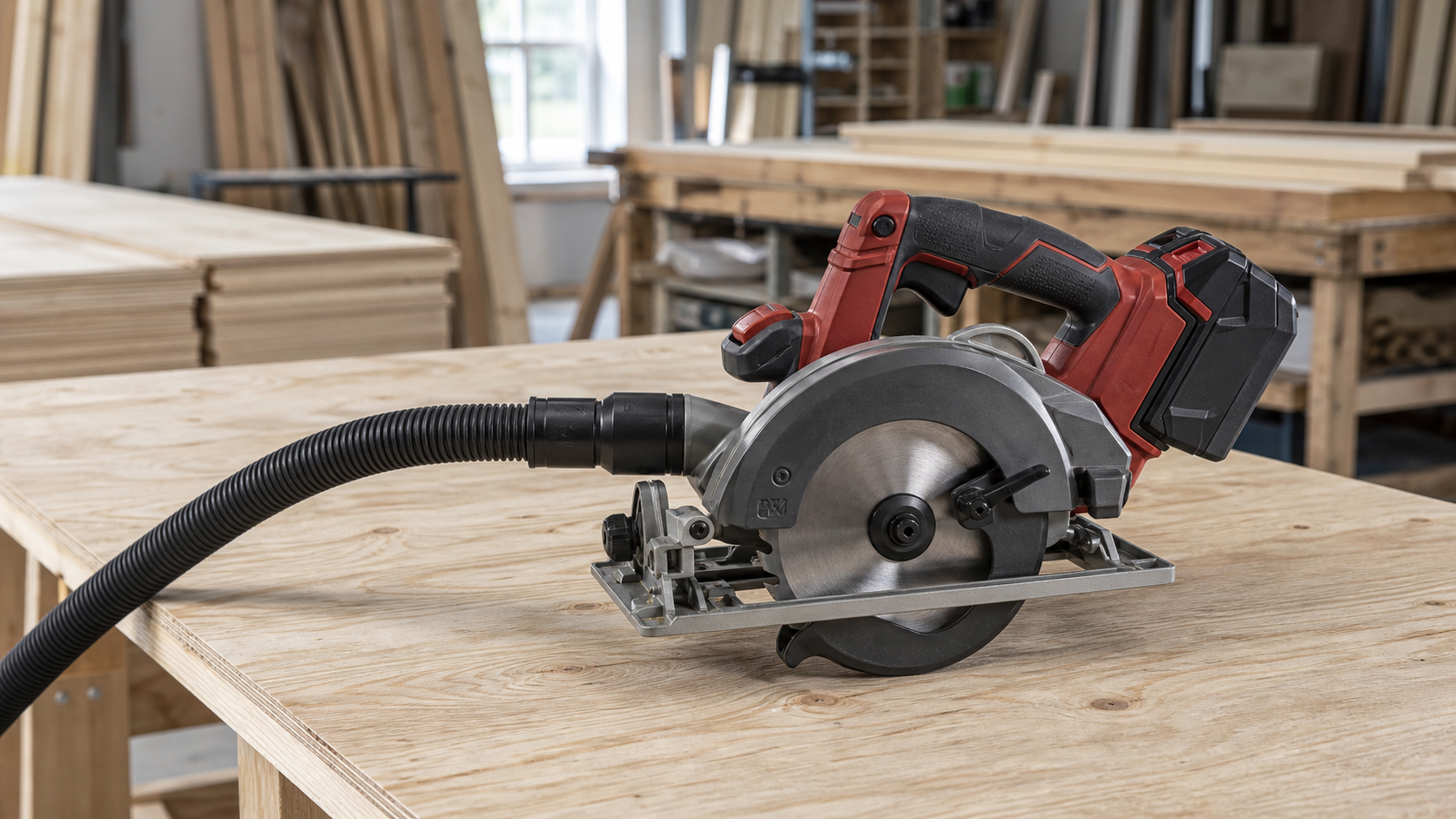
The short answer: choose the Milwaukee 2930 if you want the core cutting performance at the lower price. Choose the 2931 if ONE-KEY inventory tracking, AUTOSTOP kickback protection, and VACLINK wireless dust-extractor activation will materially improve your work. Milwaukee publishes the same blade size, speed, cut capacity, and bevel range for both saws, so the 2931 is primarily a technology and workflow upgrade—not a higher-capacity cutting platform.
Both are M18 FUEL 7-1/4-inch rear-handle circular saws aimed at professional carpenters, remodelers, and contractors. The 2930 arrived as Milwaukee’s lighter second-generation rear-handle model, while the 2931 adds connected-tool and safety features around the same basic cutting package.
Milwaukee 2930 vs. 2931 at a glance
| Feature | 2930-20 | 2931-20 |
|---|---|---|
| Blade | 7-1/4 in., 5/8-in. arbor | 7-1/4 in., 5/8-in. arbor |
| No-load speed | 6,000 RPM | 6,000 RPM |
| Maximum cut at 90° | 2-5/8 in. | 2-5/8 in. |
| Maximum cut at 45° | 2 in. | 2 in. |
| Maximum bevel | 53° | 53° |
| ONE-KEY | No | Yes |
| AUTOSTOP | No listed feature | Yes |
| VACLINK | No | Yes, with compatible extractors |
| Rotating dust port | Yes | Yes |
Milwaukee’s official launch materials list both tools at 8.3 pounds bare and 11.6 pounds with an M18 REDLITHIUM FORGE HD12.0 battery. Pro Tool Reviews reports somewhat higher measured or configured weights—8.8 pounds bare for the 2930 and 8.9 pounds for the 2931. That difference is a useful reminder to distinguish manufacturer specifications from an independent reviewer’s scale and setup. Battery, blade, accessories, and measurement method can change the number you actually carry.
What the 2931 adds
ONE-KEY tool tracking and inventory management
ONE-KEY is most valuable when a saw moves among crews, trucks, and jobsites. Milwaukee describes it as a Bluetooth-connected inventory system that can record tool information and help managers see where a tool was last detected. A single owner who keeps the saw in one shop may not gain much from that feature. A contractor managing several tools across multiple people has a clearer reason to pay for it.
ONE-KEY should not be mistaken for live GPS. Its practical value is inventory visibility and tool-management history within Milwaukee’s system. Before choosing the 2931 for this feature, confirm that your company will actually maintain the ONE-KEY records; connected hardware is only useful when it fits an existing process.
AUTOSTOP advanced kickback protection
Milwaukee says the 2931 can detect a severe kickback event and shut off power. That is a meaningful additional safeguard, but it does not replace correct support, a suitable blade, two-handed control, or attention to the cut path. Binding can still occur when sheet goods sag, an offcut closes on the blade, or the operator twists the saw away from a straight line.
Pro Tool Reviews also observed that the 2931 stopped its blade faster than the standard 2930 during a side-by-side brake comparison. That is an independent test result, not a ToolCurve hands-on claim. The main purchasing question is whether the added electronic protection justifies the upgrade for the conditions in which your saw will be used.
VACLINK wireless dust control
VACLINK allows the 2931 to trigger a compatible Milwaukee extractor when the saw starts. It solves the easy-to-forget step of switching the vacuum on before a cut and can keep the extractor running briefly afterward to help clear the hose. The 2930 has a rotating dust port and included vacuum adapter, but not the VACLINK wireless activation listed for the 2931.
VACLINK does not replace the physical hose connection. You still need a hose and cuffs that fit the tool-side adapter and the extractor. If you mix Milwaukee tools with a Festool extractor or a standard shop vacuum, measure and verify both ends rather than ordering by the vacuum brand alone. Nominal hose names such as 27 mm, 36 mm, 1-1/4 inch, and 1-7/8 inch do not always describe the same part of the cuff. ToolCurve’s hose-adapter collection can help bridge mixed-brand systems, but exact tool-model compatibility should be confirmed on the individual product page before ordering.
How the 2930 improves on the older 2830
The 2930 is not merely the 2830 without ONE-KEY. It is Milwaukee’s newer base platform. Compared with the previous 2830, Milwaukee increased published no-load speed from 5,800 to 6,000 RPM and maximum 90-degree cut depth from 2-1/2 to 2-5/8 inches. The newer saw also adds depth detents at 1/2, 3/4, and 1-1/2 inches, bevel detents at 22.5 and 45 degrees, a rotating dust port, and a redesigned lower guard.
The extra 1/8 inch of depth allows Milwaukee to describe the saw as capable of cutting 3x material in one pass. That claim is about capacity; it does not guarantee a clean result in every 3x board. Actual performance depends on material, blade condition, battery state, support, and feed rate.
In its hands-on review, Pro Tool Reviews used the new saw for crosscuts, bevel cuts, and long rips in stacked sheet material and reported that it maintained speed well. ToolCurve has not independently tested either model, so those observations should be credited to the reviewer rather than presented as our own experience.
Which rear-handle saw is the better fit?
Choose the 2930 when:
- You want the second-generation motor, cut capacity, and lower weight without paying for connected features.
- You already switch your extractor manually or use a non-VACLINK vacuum.
- The saw belongs to one person and ONE-KEY inventory tracking would go unused.
- You would rather put the price difference toward a suitable blade, battery, hose, or material-support setup.
Choose the 2931 when:
- AUTOSTOP’s added kickback response is important to your risk-management approach.
- You manage tools across employees, vehicles, or jobsites and already use ONE-KEY.
- You own or plan to use a VACLINK-compatible extractor.
- The added features will be used often enough to justify the higher purchase price.
At their published tool-only launch prices, Milwaukee placed the 2930 below the 2931. Street prices, bundles, and promotions change, so compare the current total package—not only the bare-tool sticker. A kit may include a battery size you need, while a bare tool may be the better value for someone who already owns suitable M18 packs.
Dust collection details worth checking
A rotating port helps route the hose away from the cut, but hose management still matters. Provide enough slack for the full cut, keep the hose behind the saw, and make sure it cannot pull the shoe off line. Extraction can reduce cleanup and airborne debris, but it cannot capture everything thrown by an open circular-saw blade. Eye protection and appropriate respiratory controls remain important, especially when cutting engineered wood, treated lumber, masonry-containing products, or materials with unknown coatings.
Before adding any adapter, verify three items: the exact saw model, the outside geometry of the supplied vacuum adapter or dust chute, and the hose cuff that will connect to it. Do not force a tight fitting onto the saw or use an arrangement that restricts the guard, depth adjustment, bevel movement, or the operator’s grip.
Setup and safety checks before the first cut
Read the model-specific Milwaukee operator’s manual before use. Remove the battery before installing a blade, adjusting components near the blade, clearing debris, or attaching accessories that require your hands near the guard. Confirm the blade is suitable for the material, installed in the marked direction, and rated for the saw. Support the work so the kerf stays open, keep both hands on the designed gripping surfaces during a cut, and wait for the blade to stop before setting the saw down.
A dust extractor, electric brake, and AUTOSTOP are layers of protection—not substitutes for a stable workpiece and a controlled cut. The 2931 adds useful technology, but the safest choice is still the model whose features you understand and will use consistently.
Bottom line
The Milwaukee 2930 and 2931 deliver the same published cutting capacity, speed, blade size, and bevel range. For most individual owners, the 2930 is the straightforward value choice. For crews and contractors, the 2931 can earn its premium through ONE-KEY inventory management, AUTOSTOP kickback response, and VACLINK extractor activation.
Decide based on workflow rather than the model number alone. If the 2931’s three added systems solve problems you already have, it is the stronger fit. If they would remain unused, the 2930 gives you the same core saw performance with less technology to pay for.
Comments