The Makita LS610DZ is an 18V cordless sliding miter saw with a 6-1/2 in. (165 mm) blade. You can carry it with one hand and toss it in the truck. After using it for shelves and trim, we think it’s one of the best saws we’ve ever owned.
Some links in this article go to Amazon. As an Amazon Associate, ToolCurve earns from qualifying purchases.
It isn’t for everyone, though. The blade is small and the slide is short. When we bought ours, it was a Japan-market saw, so we had it shipped from Japan, and that shipping wasn’t cheap. Check availability where you live before you plan around one.
Here’s what it does well, where it falls short, and what to check before you buy.
Blade, bore and battery
The LS610DZ is the tool-only package, with no battery or charger. It runs on Makita’s 18V LXT batteries and has a brushless motor rated at 5,000 rpm. Makita lists 155–165 mm blades with a 20 mm bore. The standard blade is part A-69244.
That bore matters when you shop for blades. Lots of 165 mm blades are sold for track saws, but a matching diameter doesn’t mean the bore, kerf or tooth design suits this saw. Buy blades that list a 20 mm bore and a speed rating at or above 5,000 rpm.
On power, we’ve had no problems on 18V so far. The cherry test cut is at the end.
Why we wanted something this small
We used to own Makita’s 36V 10-inch sliding miter saw. It was a great saw. Our problem was size: a very large base and plenty of weight. To us, the whole point of a battery saw is portability. If a cordless saw is going to be that big, we’d rather run the corded version.
We don’t do much crown work, so we don’t need huge capacity. We do want a slide, and that’s what drew us to the LS610DZ.
How it compares to Makita’s US 6-1/2 in. saw
In the US, Makita sells the XSL05Z, an 18V 6-1/2 in. compact dual-bevel compound miter saw with no slide. It’s easy to think of it as the same saw without rails, but the specs differ. The XSL05Z uses a 5/8 in. arbor, and Makita lists its straight-cut capacity at 1-13/16 × 3-5/8 in. The LS610DZ uses a 20 mm bore and crosscuts about twice as wide.
Front rails and wall clearance
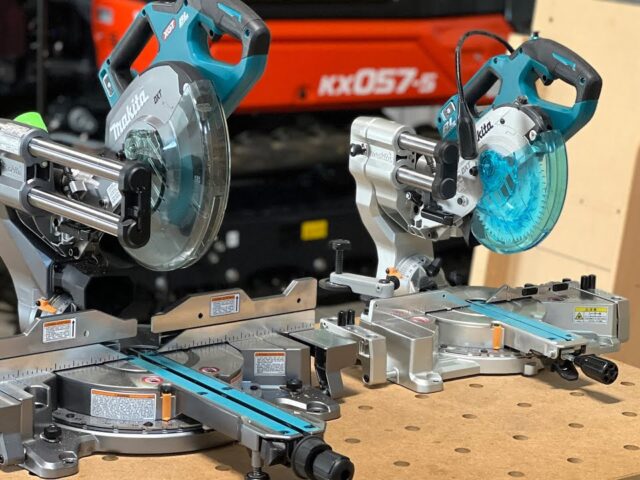
The LS610DZ borrows design cues from Makita’s bigger 36V saw. The rails sit at the front instead of sliding out the back. With the slide locked, you can push the saw right up against a wall and the head slides forward to cut. On a cramped jobsite or a small bench, that saves real space.
The sub-base wings double as stops
Our saw has Makita’s optional sub-base, part 191B97-3. Each wing adds support and doubles as a short fence or stop. The wings have holes, so you set one where you need it, screw it down and lock it with a small nut at the back. Then butt your workpiece against it for repeat cuts.
It takes longer to set than the flip stop we’ve seen on a Metabo saw. For repeat cuts around 12 in., though, it’s a nice feature. There’s also a small flip-up fence extension for extra support.
The wings are sold one per box. We bought two since we were shipping from Japan anyway, but we only ever use the left one. Realistically, one is all you need. Makita lists the same sub-base for the 40V LS001G. We suspect it may fit the US XSL05Z chop saw too, but we haven’t confirmed that, so don’t count on it.
Makita also sells a shoulder strap, part 162741-7, that clicks onto the saw. We don’t own it, so we can’t say how comfortable it is to carry a 22 lb saw over your shoulder.
Laser and work light
There’s a laser you can dial in, plus an LED work light. We use the light often, but it mainly brightens the work area. On a DeWalt DWS780, the light sits above the blade and casts the blade’s shadow onto the workpiece, which gives you a cut line. We like that approach. If you position the Makita’s light toward the front, you get a bit of a line, but it’s really designed as a work light.
Capacity: our one real complaint
This is a trim saw. With a 6-1/2 in. blade, it isn’t going to cut 4×4s. For trim, shelving and laying laminate flooring, it’s a really nice saw.
Our only real issue is the slide. Makita rates straight-cut capacity at 46 × 182 mm, about 1-13/16 × 7-3/16 in. With a 20 mm auxiliary facing on the fence, it’s 55 × 150 mm, about 2-3/16 × 5-7/8 in. We’d have liked longer rails.
Metabo HPT has a similar compact slider that’s priced around $1,200, and we think it crosscuts 12 in. or more. Maybe Makita kept the rails short to avoid deflection or slop. If the LS610DZ cut 12 in. wide, it would be hands down the best miter saw we’ve ever owned.
In practice, it rarely gets in our way. Anything around 14–15 in. wide goes to the track saw on our MFT table anyway.
The 40V version: LS001G
Makita also makes this saw for its 40V max XGT batteries as the LS001G. It has the same footprint and the same straight-cut capacity, but it isn’t identical:
| Spec | LS610DZ (18V) | LS001G (40V max) |
|---|---|---|
| No-load speed | 5,000 rpm | 4,200 rpm |
| Straight-cut capacity | 46 × 182 mm | 46 × 182 mm |
| Dimensions (L × W × H) | 495 × 400 × 470 mm | 495 × 400 × 470 mm |
| Weight with battery | 10.2 kg (BL1860B) | 10.3 kg (BL4025) |
| Sub-base 191B97-3 / strap 162741-7 | Listed | Listed |
We haven’t used the LS001G, so we won’t guess which one cuts better. For us, the bigger issue is batteries. XGT batteries don’t work on 18V LXT tools, so going 40V means buying into a whole new battery line. We already have a lot of Makita 18V batteries and haven’t hit a power wall, so the LS610DZ made more sense.
Build, detents and dust collection
The detents are strong and lock positively. The whole saw feels very well built and extremely stable.
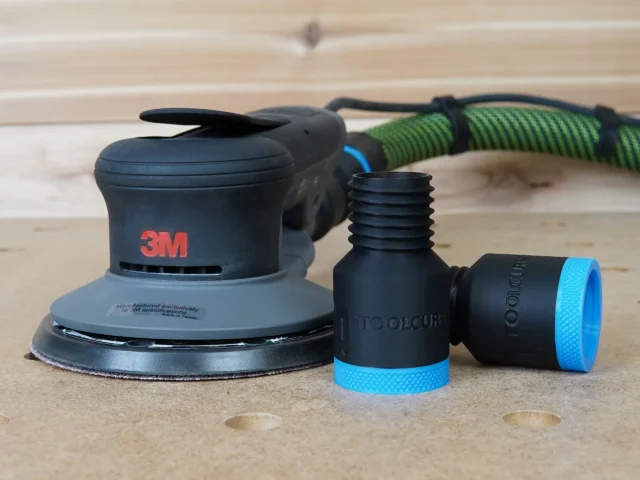
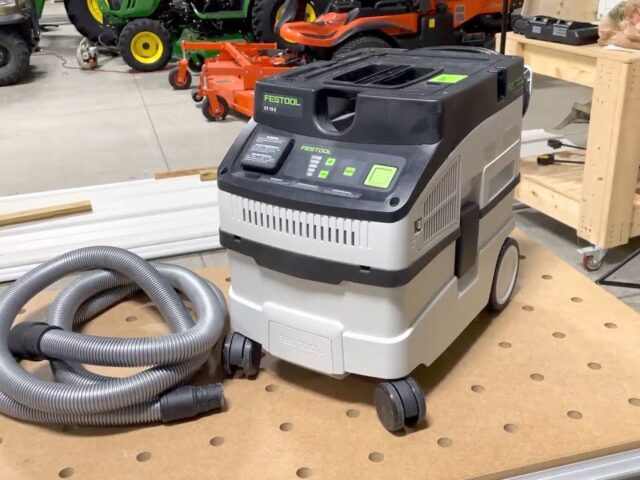
Dust collection surprised us. Hooked to a shop vac, the rear port worked a lot better than most miter saws we’ve used. The saw comes with a dust bag, but a vacuum is the way to go. One catch: our Festool 27 mm hose didn’t fit the port, so we 3D printed our own adapter. Check your hose against the port before you count on a direct connection. For other saws and hose sizes, see our hose adapters.
Precision, and the Kapex comparison
A knob at the back lets you fine-tune the setting when you need to dial in a cut exactly. We’ve built shelves and done trim with this saw, and it’s extremely precise.
We’re big Festool users, and when we first got the LS610DZ, we called it the next best thing to a cordless Kapex. Festool has since released one, the KAPEX KSC 60 EB. We cover it in our KSC 60 specs and update. Part of why we preferred the Kapex over the big Makita 36V saw was its compact size, and the LS610DZ is more compact still. Compared with a 10-inch saw, you give up blade size and crosscut width.
Bluetooth auto-start
The saw supports Makita’s wireless auto-start. Add the optional wireless unit (WUT01, part A-66151) and a compatible Makita Bluetooth vacuum, and the vac starts when the saw does.
Our gripe is that you need a separate chip for every tool, on top of the vacuum. You can buy them singly or in multi-packs, but the cost adds up. Festool builds Bluetooth into its batteries instead, so a Bluetooth battery can trigger the extractor from its cordless tools, older ones included. We think that’s the better approach. We’d like Makita to do the same, but we don’t expect it.
Test cut in cherry
We crosscut a piece of cherry just under 1 in. thick. The saw didn’t bog down, the blade didn’t slow, and the battery was only about half charged. Everything we’ve thrown at this saw has gone through without trouble. With a 6-1/2 in. blade, you won’t be cutting thick oak anyway. If you take it slow on dense stock, we’d be surprised if 18V held you back.
Should you get one?
If you’re already on Makita 18V and mostly cut trim, shelving or flooring, the LS610DZ is our pick for a portable sliding saw. It was our go-to miter saw until we moved up to Makita’s 8-1/2 in. 40V GSL02Z for more crosscut capacity. If you regularly crosscut boards wider than about 7 in., or you need crown capacity, a bigger saw or a track saw will serve you better. For more capacity in a saw you can still carry, see our Makita 40V XGT 8-1/2 in. miter saw review.
Before you buy, check availability and shipping cost, plan on 20 mm bore blades, and make sure your vacuum hose fits the dust port.
Comments