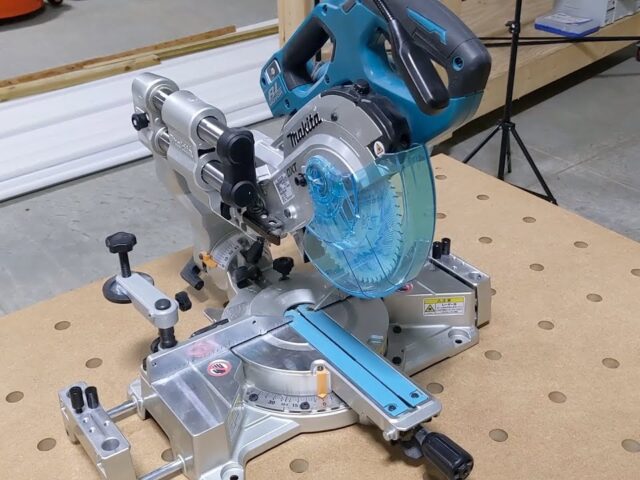
When we filmed our video in July 2022, we’d been running Makita’s GSL02Z, the 40V max XGT 8-1/2-inch dual-bevel sliding compound miter saw, for about four or five weeks. For trim work and jobs where you carry the saw in and out, it’s the nicest miter saw we’ve used, and it isn’t close. That’s partly personal, because it happens to check every box we care about. Below is what we like, the one thing that bugs us, and what to check on batteries, blades and dust collection before you buy.
The saw we had before this one
Before the GSL02Z, our compact trim saw was a Japanese-market Makita LS610D-family saw. Makita doesn’t sell it in the States, so we custom ordered it from Japan. It’s an 18V saw with a 165 mm blade, and the build quality is excellent. It’s a great little trim saw, but the 8-1/2-inch saw was the one we’d really wanted, mostly for the extra capacity. We cover that saw in our Makita LS610DZ overview.
If you’re moving between the two, the blades don’t cross over. The LS610D takes a 165 mm blade with a 20 mm bore. The GSL02Z takes an 8-1/2-inch blade on a 5/8-inch arbor.
A quick word on XGT vs. LXT
XGT is Makita’s 40V max platform. LXT is the 18V platform, and some LXT tools run two 18V batteries for 36V. The two battery systems are separate. XGT batteries run XGT tools and LXT batteries run LXT tools, so switching platforms means buying new batteries and chargers.
That switch is annoying when you already own a pile of Makita 18V gear. For impact drivers and other light tools, you don’t need XGT. On the more power-hungry tools, though, we do notice a difference, so we’re slowly moving over to XGT. We think it’ll be worth it in the long run.
The GSL02Z is sold tool-only. The battery and charger are extra.
GSL02Z specs that matter
| Spec | GSL02Z |
|---|---|
| Platform | 40V max XGT, brushless |
| Blade / arbor | 8-1/2 in. / 5/8 in. |
| No-load speed | 4,800 RPM |
| Capacity at 90° | 2-3/4 in. × 12-1/4 in. |
| Miter range | 60° left and right |
| Bevel range | 48° left and right |
| Other features | Front bevel control, retractable extension wings, rail-forward design, LED shadow line, two dust ports |
| Included | Tool only. The battery, charger and AWS transmitter (198901-5) are sold separately. |
The 12-1/4-inch figure is crosscut capacity. For trim, baseboard and flooring, that’s plenty.
Why the 8-1/2-inch instead of the 10 or 12
Makita also makes 10- and 12-inch miter saws in both the 18V and 40V lines. We picked the 8-1/2-inch for portability. The bigger saws have much larger bases and feel bulky to haul around. This one has more capacity than our old 165 mm saw and is still far slimmer than the 10- and 12-inch models. If you need a bigger cut every day, look at the larger saws. For fast trim work, we’d pick this one.
Front bevel adjustment and detents
This is one of our favorite features. Festool has always had the nicest bevel adjustment, right at the front of the saw. Makita put theirs at the front too. You loosen the knob, set the angle, then lock it down. Normally you’d hold the head with one hand and tighten with the other. That beats reaching around the back of the saw to unlock things.
You can also lock the miter in the detents, or just swing it until it clicks into place.
Built-in extension wings
The GSL02Z has adjustable extension wings on both sides. On our smaller Japanese saw, each wing was a separate purchase. Here they’re built in. That makes this a saw you can run as your main miter saw for trim and flooring jobs, with no add-ons to buy.
Battery life
We ran it on a 4.0Ah XGT battery. Over those first four or five weeks of steady use, we charged it maybe twice. We haven’t run a formal runtime test, but battery capacity hasn’t been an issue for us.
Dust collection and Makita’s port sizes
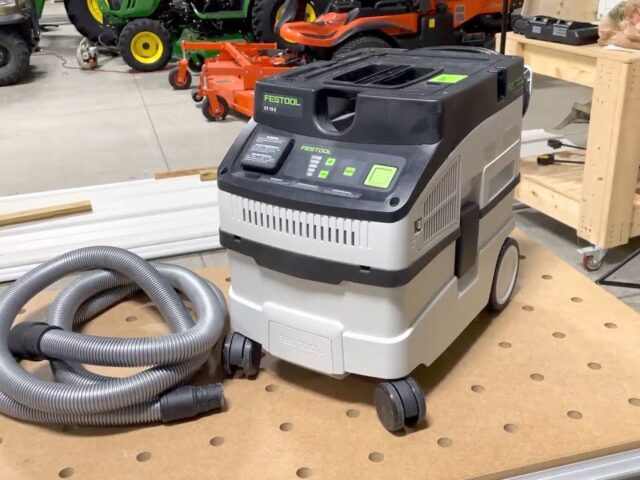
Dust collection is good. We ran the saw with a Festool extractor and hose connected to the rear port, and it kept up well. Brands are getting better at this.
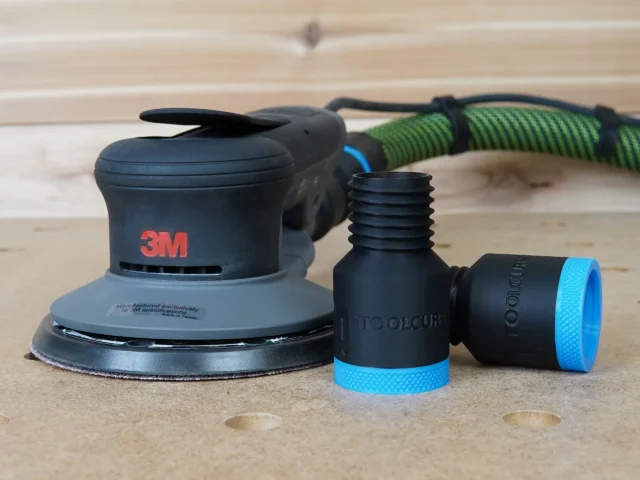
Our one gripe is ports. Makita uses its own port sizes, and they aren’t consistent. The two dust ports on this saw aren’t even the same size as each other. We think it’s partly a push to sell matching vacs, and DeWalt and others do the same thing. Either way, a lot of the hoses you already own won’t fit without help.
That’s why we make hose adapters for Festool 27 mm and 36 mm hoses and for standard shop-vac hoses like a RIDGID 1-7/8-inch. For this saw, that’s our hose adapter for the Makita 40V GSL02. Check that the listing names your hose end before you order.
Vacuum auto-start: Makita AWS vs. Festool Bluetooth batteries
This is our only real complaint. Makita builds its Auto-Start Wireless System (AWS) into the tool. On the GSL02Z, you add the separately sold 198901-5 transmitter, and the saw can then start a paired AWS vac.
Festool puts Bluetooth in the battery instead. Pop a Bluetooth battery into a compatible tool, and the paired, Bluetooth-equipped extractor starts when the tool does. That’s the right way to do it, because a new battery can bring auto-start to an older tool. With Makita’s approach, an older tool with no AWS support stays without it. We’re admittedly biased, since we’re deep into the Festool lineup.
We’d like this saw to start our Festool extractor automatically. Makita’s WUT02U Auto-Start Wireless Universal Adapter is the route we’re looking into. It’s made to pair AWS tools with most AC extractors that have a tool-activated outlet. We haven’t tried it with our extractor yet, so confirm your exact vac model first.
Folding, carrying and the D-handle
The saw folds down compact, and there’s a built-in carry handle, so you can pick it up and go. Makita has also gone with a D-handle grip, similar to Festool’s KAPEX. When we first got our KAPEX, we weren’t sure about that style. After using these saws for a while, we like it quite a bit. It feels more intuitive and leaves less room to mess something up. It should also suit lefties and ambidextrous users.
When we first got the GSL02Z, Festool’s cordless KAPEX wasn’t out yet. It’s now the KSC 60 EB, and we haven’t compared the two.
Cutting cherry
We cut cherry for the demo with the Festool extractor running. We felt no resistance at all. The saw went right through, smooth, with no sign of running short on power.
For years we used DeWalt’s corded 12-inch miter saw, the one a lot of people treat as the industry standard. Honestly, this cordless saw feels like it has more power. That’s a feel comparison, not a measured one, but brushless tools have closed a lot of the gap with corded saws.
The LED shadow line beats a laser
The GSL02Z uses an LED that casts the blade’s shadow onto the board to show your kerf. More brands are moving to this, and we prefer it to lasers. A laser has to be adjusted and kept on line. A shadow line is the actual shadow of the blade, so it lands where the blade will cut every time. If you change blades and the kerf changes, the line changes with it.
Verdict
We wanted a cordless, portable, lightweight saw for trim work, and the GSL02Z checks every box. The one thing we’d add is a zero-clearance insert. If you’re already on XGT, or planning to move there, we think this saw is well worth it.
If you’re staying on LXT, remember that this saw won’t take your 18V batteries. If you rely on tool-triggered vac starts, budget for the AWS transmitter. If you use a non-Makita extractor, budget for a way to link it, such as the WUT02U. Have a question about the saw? Ask us, and we’ll answer it.
Comments